Selecting the right orthopedic implant manufacturers is a clinical and operational decision, not merely a purchasing exercise. The choice can influence surgical outcomes, inventory stability, patient confidence, and long-term costs. A reliable manufacturer should demonstrate controlled production, qualified personnel, consistent materials, and traceable documentation. Their claims should be supported by verifiable evidence, not attractive brochures alone.
Practical evaluation begins with the details. Ask how titanium, cobalt-chrome, polymers, or coatings are tested before production. Review inspection records, sterilization controls, packaging procedures, and batch traceability. Examine their quality management systems and relevant regulatory clearances. Independent audits can reveal weaknesses that sales presentations hide. Small details matter. A mislabeled tray or unclear lot record can create serious delays in the operating room.
Experience also deserves careful attention. Experienced orthopedic implant manufacturers understand surgical workflows, instrument compatibility, and the pressure of urgent supply needs. Request feedback from surgeons, hospitals, and distribution partners who have used their products consistently. Assess design support, training, complaint handling, and post-market surveillance. Ask difficult questions. Notice whether the answers are specific, documented, and timely.
There is no perfect supplier. Even respected companies may have limited capacity, communication gaps, or uneven support across regions. A thoughtful buyer should record these concerns rather than overlook them. Comparing manufacturers through a structured checklist can improve objectivity, but professional judgment remains essential. The strongest partnership combines technical competence, transparent communication, dependable delivery, and a shared commitment to patient safety.
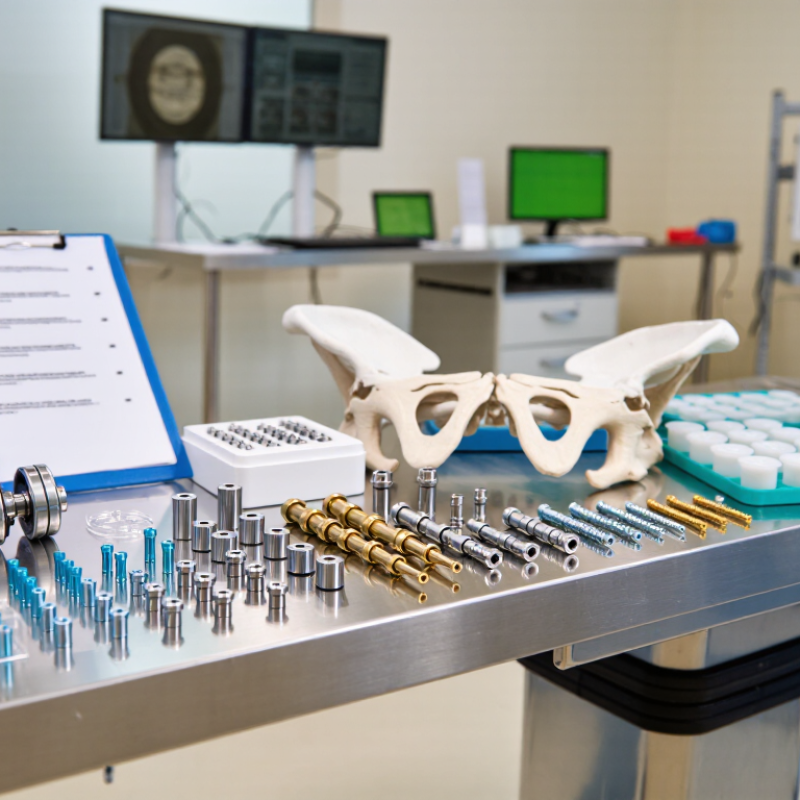
Define the Clinical Requirements for the Orthopedic Implant
10 Tips for Choosing Orthopedic Implant Manufacturers
Define the Clinical Requirements for the Orthopedic Implant
Clinical requirements should guide every manufacturer discussion. Start with the patient, not the product brochure. Document anatomy, bone quality, activity level, surgical approach, and expected loading conditions. Also define fixation needs, implant materials, imaging compatibility, and available instruments. These details affect safety and operating-room efficiency.
The World Health Organization reports that musculoskeletal conditions affect about 1.71 billion people worldwide. This large burden does not justify a generic implant strategy. The National Joint Registry’s 21st Annual Report tracks more than 3.5 million hip and knee procedures. Its long-term evidence shows why survivorship, revision rates, and patient-reported outcomes deserve attention. Ask manufacturers for peer-reviewed evidence involving similar patients and procedures. A laboratory result alone is not enough.
Tip: Build a clinical requirement sheet before requesting quotations. Include measurable targets, such as range of motion, fixation time, wear performance, and revision thresholds. Verify sterilization, packaging, traceability, and surgeon training requirements. A credible manufacturer should explain testing limits and adverse-event handling clearly. I would also request raw outcome data, not only selected success rates. That takes more time. It may prevent a costly mismatch.
Clinical teams should review the specification together. Engineers may prioritize tolerances, while surgeons notice workflow problems. Nurses often identify packaging or instrument delays first. Revisit the requirements after trial use. The original specification may be incomplete. That is normal, but ignoring the gap is not.
10 Tips for Choosing Orthopedic Implant Manufacturers - Define the Clinical Requirements for the Orthopedic Implant
Clinical requirement framework for evaluating orthopedic implant manufacturing capability
| Tip | Clinical Requirement | Key Data to Define | Practical Example | Manufacturer Evidence to Review | Priority |
|---|---|---|---|---|---|
| 1 | Specify the anatomical site and intended procedure | Bone or joint, laterality, surgical approach, primary or revision use, and intended patient population. | Total hip arthroplasty, primary procedure, adult patient, cementless femoral fixation. | Design drawings, indications for use, surgical technique documentation, and compatibility information for the complete system. | High |
| 2 | Define the expected mechanical loading environment | Load type, magnitude, direction, frequency, fatigue duration, impact exposure, and safety factor. | A lower-limb implant should be assessed for repeated axial, bending, torsional, and impact loads during walking and stair use. | Static strength, fatigue, wear, and fixation test reports using clinically relevant worst-case configurations. | High |
| 3 | Establish the required fixation method | Cemented or cementless fixation, screw or plate fixation, press-fit requirements, porous surface needs, and revision strategy. | A cementless acetabular component may require a press-fit geometry and a surface intended to support bone ongrowth or ingrowth. | Dimensional tolerances, insertion-force data, surface-characterization results, and fixation-performance testing. | High |
| 4 | Select materials according to tissue and load requirements | Material composition, corrosion resistance, fatigue behavior, elastic modulus, wear characteristics, and biological compatibility. | Titanium alloy is commonly considered for bone-contacting structural components, while cobalt-based alloys may be selected for high-wear or high-strength applications. | Material certificates, chemical composition, mechanical-property data, corrosion testing, and biological evaluation documentation. | High |
| 5 | Define the required size range and anatomical fit | Patient anatomy, available sizes, offset or angle options, left/right configurations, modularity, and allowable dimensional variation. | A fracture fixation system may require multiple plate lengths, hole configurations, and anatomical contours to accommodate different bone sizes. | Validated sizing studies, dimensional inspection records, tolerance analysis, and fit or usability evaluation. | High |
| 6 | Set imaging and surgical workflow requirements | Radiopacity, MRI conditions, CT or X-ray artifact considerations, instrument compatibility, positioning aids, and operative time objectives. | An implant intended for postoperative MRI should have clearly defined conditions for safe scanning and documented artifact characteristics. | MRI safety assessment, imaging artifact data, instrument validation, surgical technique guide, and usability results. | Medium |
| 7 | Define sterilization and packaging requirements | Sterile or non-sterile supply, sterilization method, packaging configuration, shelf life, transport conditions, and sterile-barrier integrity. | A single-use sterile implant should maintain package integrity through the validated shelf life and specified shipping conditions. | Sterilization validation, bioburden and endotoxin controls, packaging validation, accelerated-aging data, and seal-integrity testing. | High |
| 8 | Identify biological and surface requirements | Bone or soft-tissue contact, surface roughness, coating type, coating adhesion, particulate risk, and biological response. | A porous bone-contacting surface should have controlled pore characteristics and demonstrated coating stability under the intended use conditions. | Surface characterization, coating adhesion and durability testing, particulate evaluation, and biological safety documentation. | High |
| 9 | Define clinical evidence and risk controls | Known clinical risks, contraindications, expected service life, failure modes, revision risks, and required clinical or literature evidence. | For a load-bearing implant, risk analysis should address loosening, fracture, wear, corrosion, migration, infection, and incorrect placement. | Risk-management file, failure-mode analysis, clinical evaluation, post-market surveillance process, and corrective-action procedures. | High |
| 10 | Confirm regulatory and quality-system readiness | Target market, device classification, applicable standards, traceability, change control, supplier controls, and complaint handling. | Documentation should support the applicable regulatory pathway and maintain lot-level traceability from raw material through final release. | Quality-system certification, regulatory approvals or submissions, device-history records, inspection procedures, and audit results. | High |
Note: Final requirements should be confirmed by the responsible clinical, engineering, quality, and regulatory teams for the specific implant indication and target market.
FAQS
Request the current ISO 13485 certificate, its scope, and recent surveillance-audit status. The scope should cover design, machining, cleaning, packaging, and sterilization when applicable. Paperwork alone is not enough.
Visit the facility when possible. Check cleanroom logs, calibration records, batch histories, and labeled inspection stations. Look for controlled storage, especially around titanium or cobalt-chromium components. Small gaps matter.
Review technical files, clinical evaluations, biological safety testing, and post-market surveillance procedures. Ask for complaint-response times and recall procedures. Vague answers deserve attention.
Request traceable material certificates, corrosion data, fatigue testing, and biocompatibility evidence. Ask for the actual test conditions under ISO 10993. A brochure cannot prove performance.
Look for designs addressing surgical problems, such as bone-integration surfaces, controlled wear, and accurate instruments. Compare fixation strength, range of motion, revision rates, and follow-up periods. No design is perfect.
Review clinical studies, registry data, complaint records, and post-market surveillance findings. Ask how failures are investigated and documented. Short studies can mislead.
Ask how many comparable implants can be produced monthly. Confirm critical machining, maintenance controls, inspection processes, and backup supplier plans. Advertised capacity may disappoint.
Request named technical contacts, response-time targets, design reviews, training, and documentation updates. Support should continue after delivery. Clear replies matter more than fast replies.
Include tooling, validation, testing, packaging, freight, inventory, warranty handling, and engineering changes. Also compare lead times, minimum orders, payment terms, and delayed-shipment risks. I once overlooked internal labor.
Conclusion
Choosing the right orthopedic implant manufacturers requires a structured evaluation focused on clinical needs, product reliability, and long-term cooperation. Start by clearly defining the implant’s intended use, anatomical requirements, patient population, surgical approach, and expected performance. Then assess each manufacturer’s industry experience, technical expertise, product range, and ability to provide solutions for specific clinical applications. A reliable supplier should also demonstrate robust quality management systems, appropriate regulatory compliance, traceable documentation, and relevant certifications.
Material selection, design innovation, testing methods, and proven product performance are equally important when comparing potential partners. Buyers should examine how manufacturers control material quality, validate designs, manage risks, and improve products through research and engineering. Finally, consider production capacity, supply continuity, customization options, technical training, after-sales support, communication efficiency, and total cost rather than focusing only on the purchase price. A comprehensive comparison can help healthcare organizations select a capable, responsive, and dependable manufacturing partner that supports patient safety and consistent clinical outcomes.