Orthopedic Implant Biocompatibility Testing Framework in China Manufacturing
A rigorous evaluation of biochemical safety, toxicological profiles, structural tissue integration, and regulatory compliance standards for global medical device procurement.
In modern spinal, trauma, craniomaxillofacial (CMF), and veterinary reconstructive surgeries, long-term clinical safety depends fundamentally on implant biocompatibility and mechanical integrity. As global procurement groups, hospital networks, and OEM brand holders turn to leading Chinese manufacturers for high-precision orthopedic implants, evaluating the underlying toxicological and metallurgical verification protocols is paramount.
Biocompatibility is defined per ISO 10993-1 as the ability of a medical device or material to perform with an appropriate host response in a specific application. Permanent Class III surgical implants—such as pedicle screws, locking plates, intramedullary nails, and interbody fusion cages—require comprehensive biological risk assessment to prevent systemic toxicity, localized tissue necrosis, immune rejection, or oncogenic induction over decades of implantation.
Cytotoxicity Assays (ISO 10993-5)
Evaluation of cell viability using L929 mouse fibroblast cultures. In-vitro extraction testing ensures zero leaching of toxic low-molecular contaminants or residual cutting fluids from 5-axis CNC machining processes.
Systemic & Genotoxicity (ISO 10993-11)
Acute, subacute, and chronic toxicity assays verify that metal ions (Ti, Al, V, Cr, Ni) released during physiological micro-motion remain far below Tolerable Daily Intake (TDI) limits established by international pharmacopeias.
Local Tissue Effects (ISO 10993-6)
Histological evaluation following muscular and bony implantation confirms rapid fibrous capsule minimization, direct osteoblast apposition, and zero osteolysis over 12-to-52-week implantation intervals.
Information Gain Insights for Procurement Officers
When auditing China-based orthopedic manufacturers, generic ISO 13485 registration is insufficient on its own. Tier-1 manufacturers must provide full Chemical Characterization of Materials (ISO 10993-18) combined with Extractables and Leachables (E&L) screening using GC-MS and ICP-MS analysis down to parts-per-billion (ppb) sensitivity levels.
Standardized Biocompatibility Evaluation Matrix
The following matrix outlines the compulsory biological and metallurgical safety testing required for regulatory clearance (CE Mark, US FDA 510k, NMPA Class III) of permanent orthopedic implants:
| Test Parameter | Standard Reference | Target Evaluation Endpoint | Validation Protocol |
|---|---|---|---|
| In-vitro Cytotoxicity | ISO 10993-5 / ASTM F895 | Cell lysis, inhibition of cell growth | MTT / XTT Assay cell viability > 80% |
| Sensitization & Irritation | ISO 10993-10 | Dermal reaction, intradermal reactivity | Guinea pig maximization test (GPMT) zero response |
| Chemical Characterization | ISO 10993-18 / ASTM F2450 | Organic/inorganic extractable profiling | ICP-MS metal ion quantification & GC-MS extraction |
| Implantation Histology | ISO 10993-6 | Osteointegration & local tissue reaction | Cortical & cancellous bone histology at 4, 12, 26 weeks |
| Hemocompatibility | ISO 10993-4 | Hemolysis rate, complement activation | Direct contact erythrocyte lysis < 2.0% |
| Bacterial Endotoxin | USP <85> / ANSI/AAMI ST72 | Pyrogenic response control | LAL Chromogenic Assay < 2.15 EU/device |
High-Grade Medical Biomaterials & Precision Machining Capabilities
Exploring raw material microstructures, ASTM standard compliance, and tolerances down to ±0.005mm in orthopedic device production.
The biomechanical success of orthopedic implants relies heavily on the choice of biocompatible raw materials. China's top tier manufacturers utilize imported and premium domestic medical grade titanium alloys, cobalt-chromium-molybdenum (CoCrMo), surgical stainless steels, and polyetheretherketone (PEEK).
1. Titanium Ti6Al4V ELI (ASTM F136 / ISO 5832-3)
Titanium Grade 5 Extra Low Interstitial (ELI) is the gold standard for load-bearing spinal hardware, trauma plates, and joint prosthesis components. By controlling interstitial elements (oxygen, nitrogen, carbon, and iron) to extremely low levels, Ti6Al4V ELI achieves superior fracture toughness, high fatigue strength, and an elastic modulus (~110 GPa) significantly closer to cortical bone (~18 GPa) than stainless steel (~210 GPa), dramatically reducing stress shielding phenomena.
2. Unalloyed Commercially Pure Titanium (ASTM F67 / ISO 5832-2)
CP Titanium (Grades 1 through 4) is deployed primarily in craniomaxillofacial (CMF) reconstruction systems and soft tissue anchoring plates. Grade 4 CP Titanium delivers high yield strength while maintaining excellent cold-malleability, enabling intraoperative contouring of osteotomy locking plates directly against patient skeletal geometry without micro-cracking.
3. Medical-Grade PEEK (ASTM F2026) & PEEK-OPTIMA
For spinal interbody fusion cages (ACDF, TLIF, XLIF), radiolucent PEEK polymers allow artifact-free post-operative radiological assessment via CT and MRI. PEEK’s flexural modulus (~3.6 GPa) closely matches cancellous bone, minimizing graft subsidence into vertebral endplates.
5-Axis CNC Machining
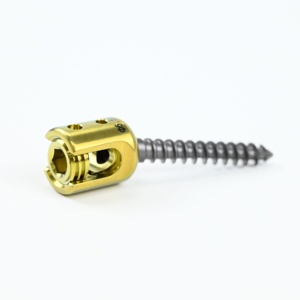
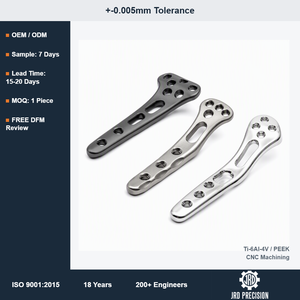
Utilizing high-precision Swiss-type turning centers and German 5-axis CNC machining centers. Complex geometry features like polyaxial pedicle screw heads and variable angle locking screw threads are executed in a single setup with tolerances held to ±0.005mm.
Anodic Oxidation & Passivation
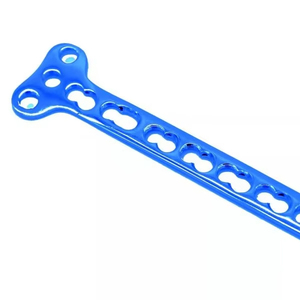
Controlled Type II electrochemical anodization per ASTM F86 creates a dense, protective titanium oxide (TiO₂) passivated surface layer. This coating eliminates free metal ion migration while providing color-coded sizing identification for surgical staff.
CMM & Optical Quality Control
100% dimensional verification using automated Coordinated Measuring Machines (CMM) and non-contact optical comparators. Thread profiles, pitch diameters, and locking taper angles are strictly verified against CAD models prior to cleanroom packaging.
Future Procurement Trends in Biocompatible Orthopedic Implants
Analyzing global market shifts, additive manufacturing adoption, regulatory convergence, and supply chain strategies through 2030.
The global orthopedic market is undergoing a major structural evolution. Procurement executives, hospital distribution networks, and original equipment manufacturers (OEMs) are re-evaluating their sourcing strategies based on four decisive technological and market vectors:
1. 3D-Printed Porous Trabecular Titanium Implants
Traditional solid titanium implants rely heavily on plasma-sprayed hydroxyapatite (HA) coatings for secondary osteointegration. The industry is rapidly transitioning toward Selective Laser Melting (SLM) and Electron Beam Melting (EBM) additive manufacturing. 3D-printed interbody cages with biomimetic trabecular pore structures (pore sizes between 400–700 μm and 60–80% porosity) allow vascularization and direct through-growth of native bone matrix, eliminating coating delamination risks entirely.
2. Regulatory Harmonization (EU MDR 2017/745 & US FDA Predicates)
The transition from the European MDD to the stringent EU Medical Device Regulation (MDR 2017/745) has elevated technical file requirements globally. Sourcing from Chinese manufacturers who maintain complete Post-Market Surveillance (PMS) data, Clinical Evaluation Reports (CER), and verified biocompatibility datasets enables global distributors to register Class III devices significantly faster in emerging and tier-1 markets alike.
3. Antibacterial & Bioactive Surface Functionalization
Post-operative implant-associated infection remains a critical challenge in orthopedic trauma and spinal revision surgery. Advanced manufacturers in China are pioneering Micro-Arc Oxidation (MAO) combined with silver nanoparticle implantation and atomic layer deposition (ALD) of antibacterial ions, creating surfaces that actively inhibit biofilm formation while encouraging osteoblast adhesion.
4. Total Cost of Ownership (TCO) & OEM Customization Agility
Leading Chinese contract manufacturers are shifting from simple build-to-print suppliers to full-service OEM/ODM partners. By integrating rapid prototyping, custom instrument kit fabrication, private-label sterile packaging, and regulatory support under one roof, international buyers can achieve up to a 35% to 50% cost reduction without sacrificing mechanical safety or clinical efficacy.
Trauhui Medical: Institutional Manufacturing & Quality Benchmark
Headquartered in Changzhou's orthopedic medical hub with over 15 years of continuous research, engineering mastery, and global supply leadership.
Founded in 2009 and strategically located in Wujin Hi-tech Zone, Changzhou City—China’s premier cluster for orthopedic device manufacturing—Trauhui Medical Co., Ltd. represents the highest standard of medical device design, metallurgical precision, and biocompatibility assurance.
With an total investment reaching RMB 200 million and a modern manufacturing footprint spanning over 30,000 square meters, Trauhui Medical operates 30+ automated production lines equipped with over 150 sets of advanced CNC machining centers, Swiss precision lathes, and automated testing equipment. The company's annual output exceeds 350,000 finished implant and instrument units.
Certified ISO 13485 QMS
Operating under a TÜV-audited ISO 13485 Quality Management System. Cleanrooms meet ISO Class 7 standards, guaranteeing controlled bioburden and particulate levels prior to terminal sterilization.
CE & FDA 510(k) Ready
Products possess CE marking and FDA 510(k) clearances. Complete Technical Documentation (STED format) is readily available to support rapid distributor registration worldwide.
OEM / ODM Customization
In-house R&D staff of over 30 engineers handles everything from custom implant geometry and custom instrumentation design to laser marking and sterile Tyvek pouch packaging.
Frequently Asked Questions on Biocompatibility & Sourcing
Detailed engineering and business answers to common queries raised by international medical device buyers.
Which specific biocompatibility certifications do Trauhui Medical orthopedic implants hold?
Trauhui Medical products are rigorously tested according to the complete ISO 10993 evaluation matrix. All implants hold CE marking and FDA 510(k) clearances, and manufacturing processes are strictly certified under an ISO 13485 quality management system. Certified copies of cytotoxicity (ISO 10993-5), systemic toxicity (ISO 10993-11), genotoxicity (ISO 10993-3), and heavy metal extractables reports are provided to qualified distribution partners.
How is raw material bio-purity verified before CNC precision machining?
Every bar of raw Titanium (Ti6Al4V ELI ASTM F136 or CP Titanium ASTM F67) and Stainless Steel (316LVM ASTM F138) undergoes 100% material verification. This includes spectral chemical analysis, ultrasonic flaw detection to ensure zero internal voids, grain size microstructural analysis, and tensile strength testing. Material Test Reports (MTRs) with full heat-lot traceability are linked to every production batch.
Can Trauhui Medical provide custom OEM/ODM implant and instrument engineering?
Yes. Trauhui Medical maintains a dedicated R&D engineering team of over 30 specialists. We offer complete Turnkey OEM/ODM services—ranging from custom anatomical locking plate modifications and proprietary spine system development to customized surgical instrument tray design, private-label laser marking, and validated sterile blister packaging.
What is the standard delivery lead time for wholesale and OEM orders?
For standard catalog inventory (including spine pedicle screws, trauma locking plates, and veterinary ALPS systems), typical delivery lead time is within 15 days. For custom OEM/ODM projects requiring new tooling, machining setup, and validation protocols, delivery is scheduled individually based on design complexity (typically 30–60 days from prototype sign-off).
How do you ensure zero cleaning fluid contamination on finished implants?
Implant components undergo multi-stage automated ultrasonic cleaning utilizing medical-grade deionized water and non-ionic bio-surfactants. Cleanliness is verified using Total Organic Carbon (TOC) analysis and gravimetric particulate residue testing, guaranteeing compliance with ISO 19227 standards for medical implant cleanliness.
Where is the manufacturing facility located, and are buyer factory audits permitted?
Our global headquarters and production facilities are located at No.2 Longqing Road, Wujin Hi-tech Zone, Changzhou City, Jiangsu Province, China. We welcome prospective distributors, hospital procurement teams, and OEM brand auditors to inspect our CNC workshops, CMM testing laboratories, and ISO Class 7 cleanroom facilities in person.
Ready to Elevate Your Orthopedic Portfolio?
Request technical dossiers, full biocompatibility test reports, OEM catalog specifications, or instant factory-direct quotations from our engineering consultants.