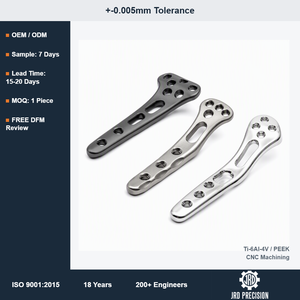
Precision 5 Axis CNC Machining ±0.005mm Titanium Ti6Al4V OEM ODM
High-precision medical grade Ti6Al4V implants manufactured under strict ISO 9001/13485 certified CMM inspection protocols.
Send an InquiryExplore our medical-grade titanium and stainless steel orthopedic implant components engineered for trauma, spinal, and veterinary reconstructive surgery.
High-precision medical grade Ti6Al4V implants manufactured under strict ISO 9001/13485 certified CMM inspection protocols.
Send an Inquiry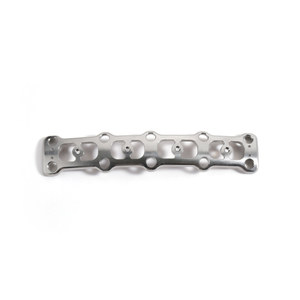
Micro-machined TC4 titanium alloy bone studs engineered for internal fixation and high structural fatigue resistance.
Send an Inquiry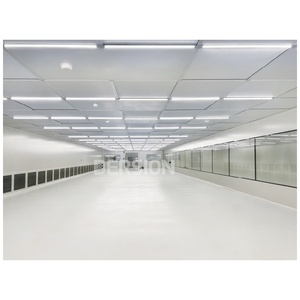
Validated cleanroom washing, passivation, and sterile packaging solutions compliant with global regulatory standards.
Send an Inquiry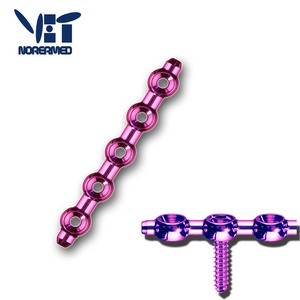
SOP anatomical locking plate system designed for small animal orthopedics, canine and feline trauma reconstruction.
Send an Inquiry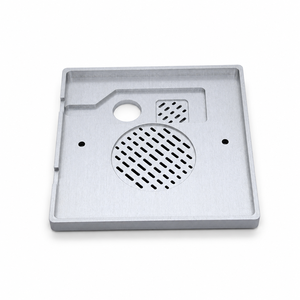
Contract manufacturing of high-complexity orthopedic joints, bone screws, and spinal fusion components.
Send an Inquiry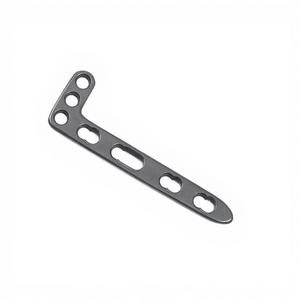
Anatomical volar and posterior mini-locking plate system crafted for hand surgery and distal radius fracture reduction.
Send an Inquiry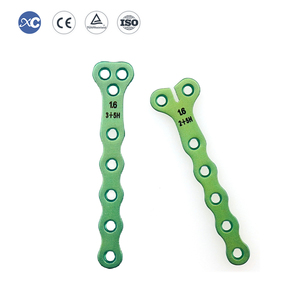
Ultra-low profile 1.6mm titanium T-plate for micro-fragment fixation in distal limb and osteotomy management.
Send an Inquiry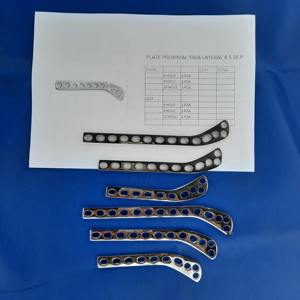
Complete 6-piece proximal tibia trauma instrument set built with surgical-grade German stainless steel (316LVM).
Send an InquiryIn the highly demanding medical device ecosystem, selecting a qualified OEM/ODM orthopedic implants manufacturer requires evaluating precision engineering capabilities, stringent quality assurance standards, cleanroom controls, and long-term regulatory compliance. Located in Changzhou, Jiangsu—the premier orthopedic industrial hub of China—our facility integrates end-to-end design, precision 5-axis Swiss CNC machining, electrochemical surface treatment, cleanroom packaging, and global regulatory registration support.
With over 15 years of continuous operational growth, an investment exceeding RMB 200 million, and a physical infrastructure spanning more than 30,000 m², our engineering teams support global distributors, OEM brand owners, and hospital procurement systems across more than 30 countries. We specialize in producing complex trauma locking plates, intramedullary nails, spinal interbody fusion devices (including 3D-printed porous titanium cages), craniomaxillofacial (CMF) plating systems, and specialized veterinary implants.
Utilizing imported Japanese Tsugami 5-axis Swiss-type automatic lathes and DMG MORI machining centers, we maintain rigorous dimensional stability down to ±0.005mm. This level of micro-precision ensures exact thread pitch alignment, optimal locking mechanism engageability, and flawless surface finishes for load-bearing surgical implants.
Production takes place under an ISO 13485:2016 audited quality management system. Final washing, ultrasonic degreasing, Type II anodization, laser marking, and double-blister sterile sealing are executed within certified ISO Class 7 (Class 10,000) cleanrooms, suppressing particulate contamination to international surgical thresholds.
We eliminate regulatory friction for international medical device importers. Every product line is backed by full technical dossiers, material test reports (MTRs according to ASTM F136/F138), biocompatibility protocols (ISO 10993), finite element analysis (FEA), and mechanical fatigue validation data compliant with CE MDR & US FDA 510(k) pathways.
The global orthopedic industry is experiencing a profound technological shift driven by advanced metallurgy, custom additive manufacturing, and biomechanical optimization. Modern surgical protocols demand implants that not only provide mechanical stability but also accelerate biological osseointegration while minimizing stress shielding.
Traditional solid implants often lead to elastic modulus mismatch between metallic alloys (Ti-6Al-4V: ~110 GPa) and native cortical bone (~18 GPa), potentially inducing stress shielding and bone resorption. Our 3D-printed porous titanium cage systems utilize Electron Beam Melting (EBM) and Direct Metal Laser Sintering (DMLS) to create interconnected trabecular structures with controlled porosity (60%–80%) and pore sizes ranging from 400µm to 700µm.
This biomimetic porous matrix mimics human cancellous bone, facilitating vascularization, osteoblast migration, and direct bone ingrowth without relying heavily on autologous graft packing.
In complex articular trauma repair, monoaxial locking plates restrict screw trajectory flexibility. Next-generation variable-angle (VA) locking systems enable surgeons to angle bone screws within a 30-degree conical envelope prior to locking into place.
By combining cold-worked Ti6Al4V plates with ultra-hard cobalt-chromium-molybdenum (CoCrMo) locking bushings or engineered thread deformation designs, our VA systems achieve robust friction locking, preventing intraoperative cross-threading while securing small fracture fragments in osteoporotic bone.
Biocompatibility and osseointegration rates are closely governed by surface topography and chemical passivation. Our automatic multi-stage electrochemical line performs Type II (colorless/gray micro-hardness layer) and Type III (color coding) titanium anodization.
Type II anodization increases the surface oxide layer (TiO₂) thickness, significantly enhancing corrosion resistance, reducing metal ion release in vivo, and increasing fatigue endurance under high cyclic stress environments (such as proximal femoral intramedullary nails).
For spinal surgery, Polyetheretherketone (PEEK Optima) remains an industry standard due to its radiolucency and biomechanical compatibility. PEEK implants allow clear post-operative radiographic evaluation via CT and MRI without metallic artifact interference.
Integrated with radiopaque Tantalum marker pins, our PEEK interbody fusion cages (ACDF, TLIF, XLIF) balance optimal stiffness, structural integrity, and anatomical fusion assessment.
Procurement executives and medical brand managers face an evolving supply chain landscape. Rising regulatory requirements, price compressions under public tender systems, and localized supply disruptions are reshaping how international buyers select their OEM/ODM contract manufacturers.
Global buyers are shifting away from fragmented multi-vendor supply chains toward centralized manufacturing hubs. Sourcing from Changzhou's dedicated orthopedic industrial cluster provides single-location access to raw material forging, precision tooling, electrochemical finishing, and testing laboratories, reducing lead times from months to weeks.
Distributors are moving up the value chain by branding proprietary implant solutions. Leading contract manufacturers now offer complete Design for Manufacturability (DFM) input, Finite Element Method (FEM) simulation, customized instrument tray design, and rapid 3D titanium prototyping to shorten product time-to-market.
Under US FDA regulations and European MDR guidelines, Unique Device Identification (UDI) is mandatory. Modern procurement requires factory-level laser etching of UDI 2D DataMatrix codes, lot-level traceability from raw bar stock melt certificates to final sterile barrier packaging.
In-depth answers regarding raw materials, quality control, regulatory documentation, custom OEM workflows, and minimum order quantities.
We strictly utilize certified medical-grade alloys imported and sourced from accredited mills with Mill Test Reports (MTRs). For titanium implants, we use Ti-6Al-4V ELI (Extra Low Interstitial, Grade 23, ASTM F136 / ISO 5832-3) and pure titanium (Grade 2/4, ASTM F67). For stainless steel trauma systems, we utilize high-nitrogen cold-worked 316LVM (ASTM F138 / ISO 5832-1). PEEK implants utilize implant-grade PEEK-Optima from Invibio.
Our manufacturing infrastructure is certified under ISO 13485:2016 QMS. Core product categories hold CE certificates under European directives/MDR and FDA 510(k) clearances. For OEM partners seeking market registration in Latin America, Southeast Asia, the Middle East, or Europe, we provide full Technical Dossiers, STED format documentation, cleanroom validation reports, gamma/EO sterilization validation, and ISO 10993 biocompatibility testing summaries.
The custom project workflow follows 5 structured phases: (1) NDA Signing & Engineering Concept Review (CAD/3D STEP files); (2) DFM Feasibility & Finite Element Analysis (FEA); (3) Prototype Machining & CMM Dimensional Verification (typically 15-20 days); (4) Mechanical Fatigue Testing (e.g., static compression/bending per ASTM F1717 / ASTM F2077); (5) Pilot Mass Production, Cleanroom Packaging setup, and Private Labeling.
Quality assurance is embedded at every machining stage. In addition to operator self-inspection, our Quality Control department operates automated Coordinate Measuring Machines (CMM with optical and tactile probes, resolution 0.0005mm), optical profile projectors, surface roughness testers (Ra targets < 0.4µm for articulating/locking surfaces), and thread gauge go/no-go checks for every batch.
For standard catalog items (spine plates, trauma locking systems, intramedullary nails), we maintain substantial safety stock in non-sterile bulk packaging, allowing order dispatch within 10 to 15 business days. Custom OEM/ODM mass production orders typically require 35 to 50 days, depending on raw material procurement, specialized tooling, anodization color specs, and sterile packaging requirements.
Yes. An orthopedic implant system cannot be deployed effectively without ergonomic, precise instrumentation. We engineer and manufacture complete matching surgical instrument sets—including drill bits, taps, sleeve guides, torque-limiting screwdrivers, benders, and sterilization trays—customized for each plate or spinal system.
Review how our industrial contract manufacturing infrastructure compares against standard device suppliers:
| Engineering Metric | Standard Tier Supplier | Our OEM/ODM Factory Standard |
|---|---|---|
| CNC Machining Axis | 3-Axis / 4-Axis Standard Lathes | 5-Axis Swiss Automatic CNC (Tsugami / DMG) |
| Machining Tolerance | ±0.02mm to ±0.05mm | Sub-micron precision up to ±0.005mm |
| Cleanroom Packaging | Outsourced or Class 100,000 | In-house Certified ISO Class 7 (10,000) Cleanroom |
| Metallurgical Traceability | Batch-level general certificate | Individual Heat/Melt MTR (ASTM F136/F138) + UDI Laser |
| Quality Certifications | ISO 9001 only | ISO 13485:2016, CE Certified, FDA 510(k) Cleared |